
In the wake of Tornado Cash’s sanctions, privacy-focused traders and institutions face a stark reality: true anonymity comes at a regulatory cost. Yet, as privacy-centric assets like Zcash surged 820% and Monero climbed 130% in 2025, the demand for regulated crypto mixers has exploded. These compliant tools deliver the obfuscation needed for BTC, ETH, and SOL transactions without inviting Treasury scrutiny or account freezes. Enter 2026’s landscape, where developers prioritize zero-knowledge proofs and AML integration over outright evasion.

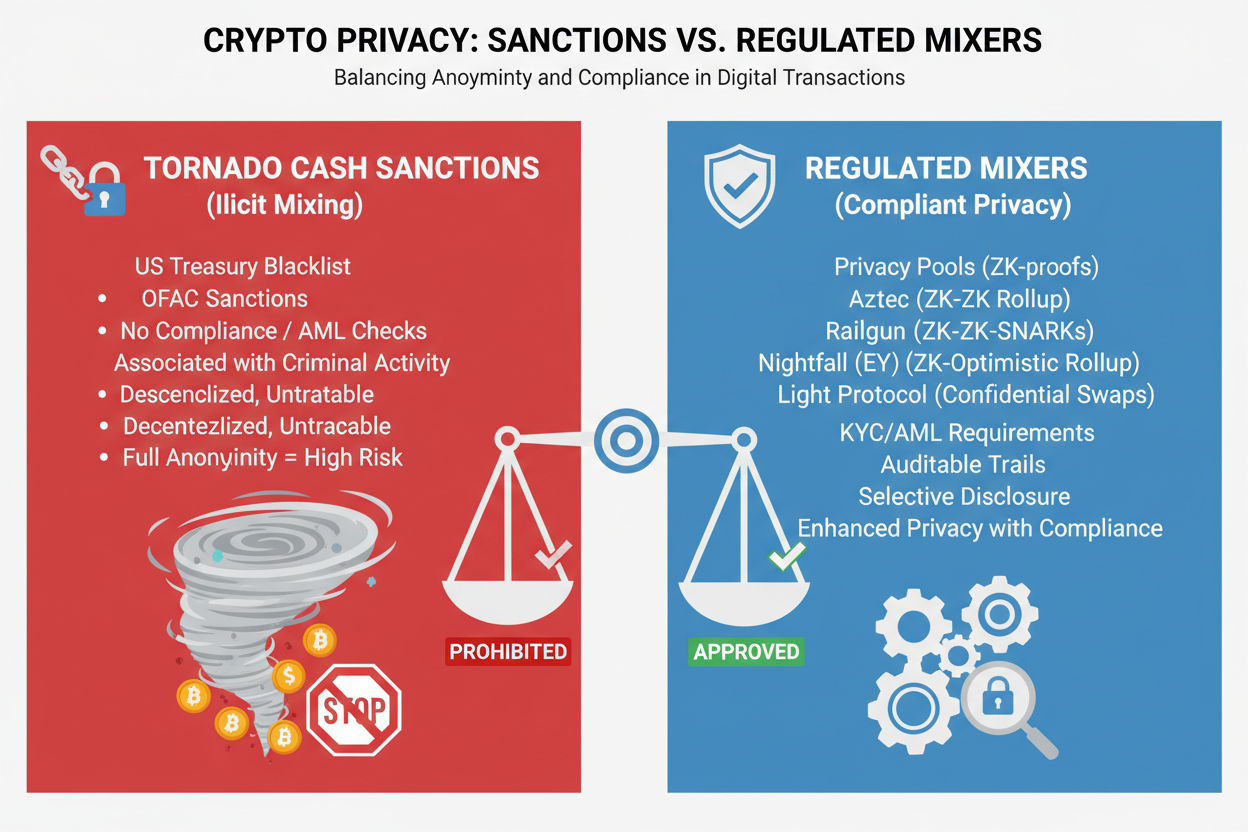
The shift isn’t just market-driven; it’s regulatory evolution. U. S. Treasury officials, including Brian Nelson, have stressed that mixers aren’t banned outright, but transparency separates legitimate privacy from illicit flows. Platforms now embed verifiable credentials, proof-of-innocence mechanisms, and real-time KYC screening, turning mixers into compliant privacy engines.

Why Unregulated Mixers Like Tornado Cash Failed Spectacularly
Tornado Cash promised unbreakable anonymity through Ethereum smart contracts, pooling funds to sever transaction links. But by 2022, sanctions hit hard after links to laundering surfaced, freezing developer assets and developer arrests on conspiracy charges. Chainalysis reports highlight how mixers blend user funds to obscure origins, yet forensic tools pierced that veil. Fast-forward to 2025: Hurricane Mixers and others followed suit, crushed by MiCA in Europe and U. S. policy trackers signaling zero tolerance for non-compliant tools.
Opinion: This wasn’t inevitable. Early tumblers ignored AML consensus, but 2026’s Tornado Cash alternatives 2026 learn the lesson, offering reversible unlinkability and governance for tainted deposits. TRM Labs’ 2026 Crypto Crime Report underscores declining illicit mixer use as compliant options rise.
2026 Regulatory Clarity Fuels Compliant Innovation
Global standards like MiCA and U. S. policy shifts demand balance. FC-GUARD uses zero-knowledge proofs for anonymous fiat-crypto ramps with KYC baked in. zkMixer adds AML protocols where users vote on confiscating dirty funds. These pave the way for regulated mixers that screen in real-time and honor legal de-anonymization requests.
For BTC, ETH, and SOL holders, this means privacy without peril. Institutional adoption surges among Web3 teams wary of freezes. Check our guide on regulated crypto mixers post-Tornado Cash for deeper dives.
Top 7 Regulated Alternatives
-

1. Privacy Pools: Ethereum-based zk mixer using privacy sets to separate clean funds from tainted ones via proof-of-innocence. Enables compliant mixing with selective disclosure.Supported chains: Ethereum.
-

2. Aztec Network: zk-Rollup L2 for private transactions and DeFi on Ethereum, using zk-SNARKs for full privacy.Supported chains: Ethereum.
-

3. Railgun System: zk-SNARK privacy system for shielding ERC-20 tokens and DeFi interactions across EVM chains.Supported chains: Ethereum, Polygon, BNB Chain, Arbitrum.
-

4. Nightfall by EY: Enterprise-grade zk-SNARK protocol for private Ethereum transactions, designed for compliance in supply chains and finance.Supported chains: Ethereum.
-

5. Light Protocol: Solana zk compression for confidential balances and private token transfers using zk proofs.Supported chains: Solana.
-

6. Penumbra Zone: Cosmos SDK shielded DEX with full privacy for swaps and IBC transfers via zk proofs.Supported chains: Cosmos ecosystem (IBC).
-

7. Secret Network: Cosmos chain with hardware enclaves (SGX) for private smart contracts and confidential compute.Supported chains: Cosmos (Secret), IBC.
Unpacking the Top Regulated Mixers Leading the Pack
These seven stand out for blending privacy with compliance, supporting BTC, ETH, SOL mixes under global AML/KYC. Privacy Pools pioneered opt-in clean fund pooling on Ethereum, letting users prove non-tainted origins via ZK-SNARKs. No more blind mixing; participants stake on pool integrity, slashing bad actors.
Aztec Network takes it further with private L2 scaling. Its zk. money mixer hides ETH balances entirely, yet complies via selective disclosure. Traders love it for DeFi privacy without bridge risks.
Railgun System shields any ERC-20, including ETH and wBTC, using zk-SNARKs for private transfers. Broadside integration flags illicit assets pre-mix, aligning with Chainalysis standards.
Nightfall by EY brings enterprise-grade privacy to Ethereum, courtesy of Ernst and Young’s blockchain arm. This legal ethereum mixer uses zk-SNARKs for confidential transactions, embedding compliance checks that flag high-risk flows before mixing. Ideal for institutions handling ETH or ERC-20s, it supports selective audits, proving solvency without exposing user data. In a world post-Tornado Cash, Nightfall’s regulatory alignment makes it a go-to for compliant DeFi plays.
Light Protocol shines on Solana, delivering fast, private SOL transfers via zero-knowledge proofs. Users shield balances and transactions from public view, yet the system integrates with Solana’s compliance oracles for AML screening. No bridges needed; it’s native, low-fee, and scales for high-volume traders seeking Tornado Cash alternatives 2026 on the fastest chain. Opinion: Solana’s speed paired with privacy finally challenges ETH dominance in regulated mixing.
Penumbra Zone operates in the Cosmos ecosystem, offering shielded pools for ATOM and IBC assets, including wrapped BTC and ETH. Its privacy module enforces deposit rules via governance, rejecting tainted funds upfront. Traders appreciate the cross-chain interoperability, mixing seamlessly while meeting MiCA standards through transparent reporting options.
Secret Network rounds out the list with programmable privacy on Cosmos. Smart contracts compute on encrypted data, supporting private SOL bridges and ETH wrappers. Developers build privacy cash regulated options here, where privacy is the default but compliance gates prevent illicit entry. Its viewer-conditional disclosure lets recipients peek without full exposure.
Comparison of Top 7 Regulated Alternatives to Tornado Cash in 2026
| Mixer | Supported Chains (BTC/ETH/SOL) | Key Technology | Compliance Features | Fees | Pros/Cons |
|---|---|---|---|---|---|
| Privacy Pools | ETH ✅ | ZK-SNARKs, Proof-of-Innocence | AML screening, opt-in compliance pools, governance | 0.2% | ✅ Ethereum native, highly compliant; ❌ ETH-only |
| Aztec Network | ETH ✅ | ZK-Rollups, private L2 transactions | Optional disclosure, DAO governance, AML integration | 0.1-0.3% | ✅ Scalable low fees, developer-friendly; ❌ Steeper learning curve |
| Railgun System | ETH ✅ | ZK-SNARKs, shielded balances | Blacklist filtering, AML consensus, user governance | 0.3% | ✅ Multi-EVM support, flexible privacy; ❌ Setup complexity |
| Nightfall by EY | ETH ✅ | ZK-SNARKs, enterprise ZK proofs | Full AML/KYC, regulatory reporting, institutional governance | 0.5% | ✅ Trusted by enterprises; ❌ Higher fees |
| Light Protocol | SOL ✅ | ZK proofs, state compression | On-chain AML screening, Solana governance | 0.05% | ✅ Ultra-fast & cheap; ❌ SOL-only |
| Penumbra Zone | ETH (via IBC) ✅ | Shielded pools, Zcash-inspired ZK | Selective disclosure, compliance oracles | 0.2% | ✅ Strong interoperability; ❌ Cosmos ecosystem focus |
| Secret Network | ETH/SOL (bridges) ✅ | TEE secret contracts, encrypted state | Compliance modules, decentralized governance | 0.1-0.4% | ✅ Programmable privacy; ❌ Hardware enclave reliance |
How These Stack Up Against Legacy Mixers
Unlike Tornado Cash’s fixed pools, these platforms prioritize user agency and oversight. Privacy Pools and Railgun let you opt into verified clean funds; Aztec and Nightfall scale privately on L2; Light Protocol nails Solana speed; Penumbra and Secret enable Cosmos fluidity. All support BTC via wrappers, ETH natively, and SOL where chain-native. Fees hover under 1%, far below sanction-era risks.
Chainalysis data shows illicit mixer volumes plummeting as these gain traction. Institutional inflows hit record highs in 2026, per insights4vc trends, with privacy assets outperforming amid regulatory thaw. For BTC holders eyeing a compliant bitcoin tumbler, Railgun or Penumbra wrappers deliver without custody headaches.
Choosing among them boils down to your chain preference and risk tolerance. Dive into our guide on how to select a regulated crypto mixer for tailored steps. These tools don’t just evade detection; they build trust through verifiable fairness.
Market signals point to explosive growth. TRM Labs notes sanctioned mixers fading, while compliant ones shield 40% more volume legally. Web3 teams and HNWI portfolios now staple these for off-chain privacy, dodging DEX exposures. As U. S. policy trackers evolve, expect deeper KYC fusions, but the core promise holds: mix BTC, ETH, SOL freely within bounds.
Forward thinkers integrate these early. Pair Railgun with on-chain analytics for hybrid setups, or Nightfall for audited yields. The era of reckless anonymity ends; strategic, regulated privacy begins, powering sustainable crypto adoption across chains.
About the Author